Autonomous Ocean Monitoring: New Insights from the Santorini Cruise
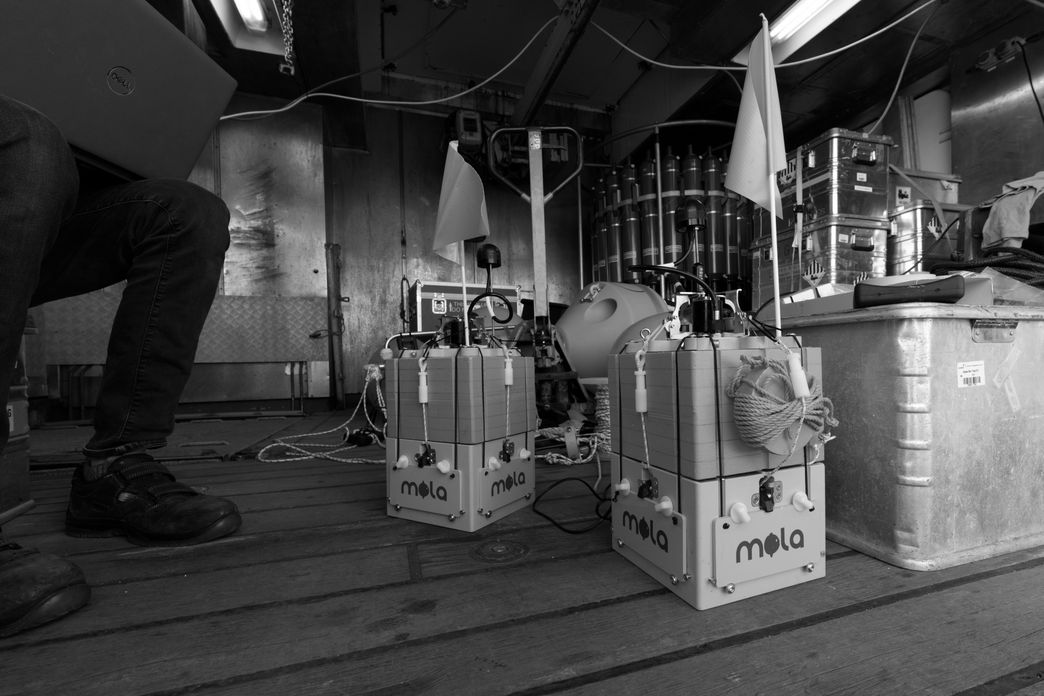
MarDATA doctoral researcher Lukas Schatternhofer recently took part in a research cruise aboard RV METEOR to Santorini, where autonomous MOLA landers were deployed on the seafloor to record and analyze seismic activity.
In this interview, he discusses his role in developing intelligent underwater sensor networks, how onboard data analysis and digital twins are shaping the future of marine monitoring, and why these technologies hold great promise for long-term observation and early-warning systems beneath the waves.
MarDATA: Lukas, you took part in the recent research cruise to Santorini with RV METEOR. What was your role on board, and how does this expedition relate to your doctoral project?
Lukas Schatternhofer: I was one of around 25 researchers on the ship. More specifically, I was part of the MOLA team. We develop a small instrument, a MOLA (Modular Ocean Lander), that drops down to the sea floor, records and analyzes seismic and other environmental data.
My role was to implement the data pipeline, deploy it on all devices, and communicate the results to the surface buoy. This aligns directly with my PhD thesis, which focuses on underwater sensor networks and their communication schemes. We need to decide what information is relevant—for example, should other MOLAs record earthquakes they heard from their neighbors, or just the ones they measured themselves?
In your project, you work on intelligent underwater monitoring systems that combine distributed sensors with digital twins. What is the core idea behind this approach, and why is it so important for marine research?
The MOLAs don't just record data, they also analyze it. Once the data is analyzed, they communicate the results to the surface, for example: "Earthquake measured at 29.12.2025 15:39 UTC+2". Analyzing the data on the MOLA is a way of reducing the amount of data to essential information. This is necessary because you can only transmit a limited amount of data through water. All electromagnetic waves are diffused, so we cannot simply use WiFi.
I use aspects of digital twins to simulate the behavior of a single MOLA or a network of MOLAs to make sure everything works before we conduct these costly real-life tests.
The MOLA landers were deployed off Santorini. Which experiences from their real-world operation most clearly highlighted where improvements are needed or possible?
While the MOLAs detected some earthquakes that match the official catalog from Athens University, we also missed some of them. Furthermore, we had many rather strange irregularities in the data that were often classified as earthquakes. From this I learned that we need to fine-tune the data pipeline further to match the device and hardware characteristics.
Of course I give up my Christmas for the opportunity to watch our MOLAs descend to the seafloor.
Lukas Schattenhofer, MarDATA Doctoral Researcher, GEOMAR
A key focus of your work is the further development of the MOLA landers. What are you working on specifically, for example in terms of autonomy, data processing, or communication?
My PhD thesis focuses on underwater sensor networks and their communication within the network. The MOLA project benefits from this research and serves as an excellent platform for testing concepts, but my solutions should be applicable to all kinds of devices. Currently, I'm working to improve the neural network that analyzes seismic data and identifies earthquakes, and I'm examining the localization data we collected during the cruise to create an interesting dataset and further experiment with different localization methodologies.
How can onboard analysis, embedded machine learning, and digital twins help make underwater monitoring systems more reliable and efficient in the future?
As long as there is no technology that can transfer significantly more data through water, onboard analysis is an effective way to reduce the need for communication while still obtaining meaningful information from the sea floor. Digital twins can be used for testing, or, if they replicate the environment, they can use live data to further improve their estimate of the real world.
Looking ahead, what potential do you see for such technologies in long-term monitoring or marine early-warning systems?
I see potential for networks of autonomous underwater sensors in early-warning systems. The combination of onboard data analysis and efficient communication protocols allows us to detect events in real-time and relay critical information to the surface quickly.
With their lightweight design, MOLAs can be deployed very easily, which makes data collection much easier and cheaper.
This combination of intelligent, cheap devices is valuable not only for seismic monitoring but also for tracking other environmental parameters, such as temperature variations, ocean currents, or biological activity. The key advantage is that these systems are easy to deploy and can operate autonomously, providing continuous monitoring from the sea floor where traditional methods are too costly.